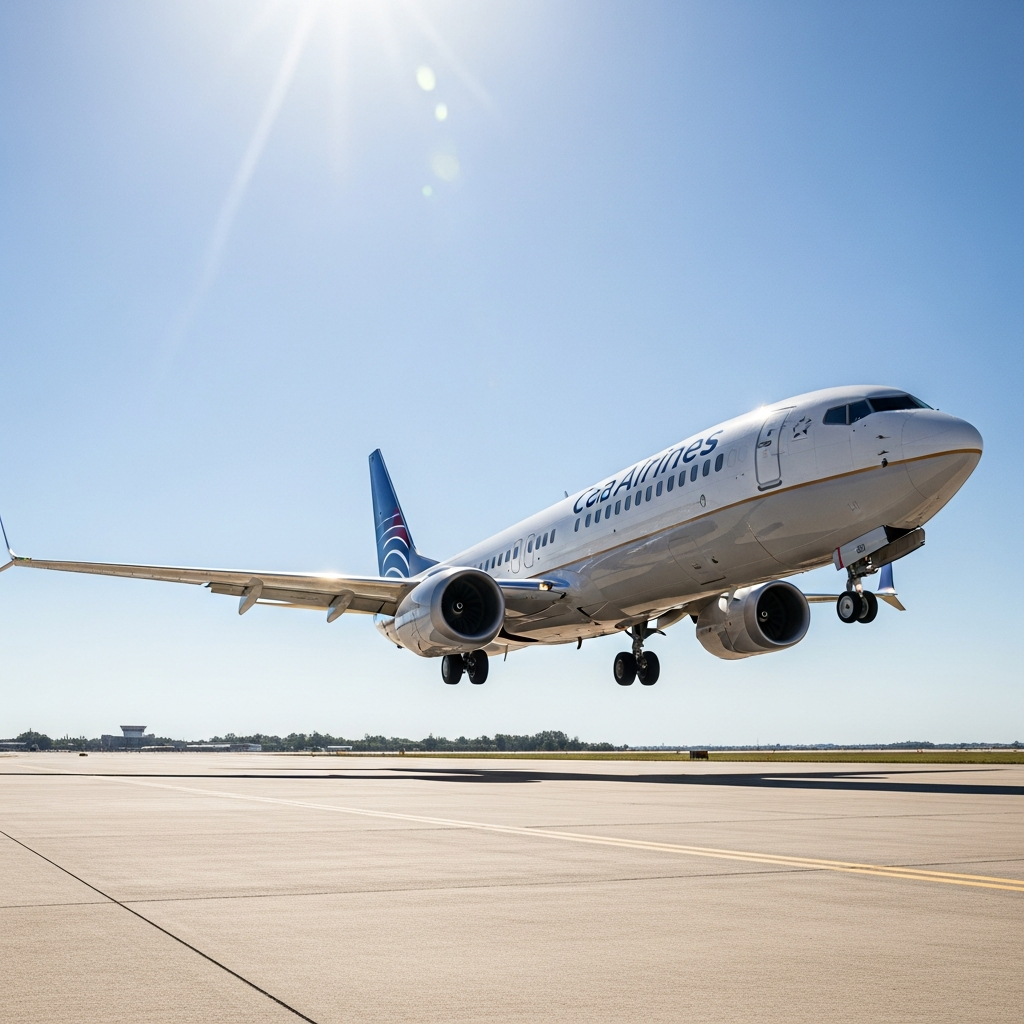
Copa Airlines and Boeing made it official Monday, April 28, 2026 — a firm order for 40 737 MAX jets, with options for 20 more, signed at a ceremony in Panama City and valued at $13.5 billion at list prices.
The deal had been sitting on Boeing’s Orders and Deliveries website as an unidentified order. Now it has a name attached. For Copa, the agreement sets up a path to surpass 200 aircraft in its fleet by 2034 — and when stacked against 40 jets already on order from a prior agreement, the Panamanian carrier could absorb up to 100 new narrowbodies over the next eight years, one of the most aggressive fleet-build programs Latin American aviation has seen.
Signing Ceremony — A Diplomatic Moment
The ceremony drew a notable crowd. Copa CEO Pedro Heilbron and Boeing Commercial Airplanes President and CEO Stephanie Pope signed the agreement alongside Panamanian President José Raúl Mulino, U.S. Ambassador Kevin Marino Cabrera, and GE Aerospace CEO Larry Culp. One head of state. A cabinet-level diplomat. The optics were deliberate — Copa’s expansion is clearly woven into Panama’s broader economic agenda, not just an airline story.
Flexibility Across Three Variants
Copa retained the right to choose between the 737-8, 737-9, and 737-10 depending on operational needs — a structuring detail that gives the airline real flexibility as it manages its connecting bank at Tocumen International Airport, its Hub of the Americas®. Deliveries run between 2030 and 2034, leaving room to adjust capacity as market conditions evolve.
The current fleet, per ch-aviation data, includes nine 737-700s, 57 737-800s, 18 737-8s, 32 737-9s, and two 737-800BCF converted freighters. The incoming jets will complement — and eventually replace — the aging Next-Generation 737-700s and 737-800s, while extending MAX operations across Copa’s network of 88 destinations in 32 countries spanning North America, Latin America, and the Caribbean. GE Aerospace engines will power the new aircraft, consistent with Copa’s existing MAX setup.
The All-737 Advantage
Copa has run an all-Boeing narrowbody fleet since 2020. That’s not an accident. A single fleet type eliminates the training overhead, maintenance complexity, and spare-parts headaches that come with mixed fleets — and Heilbron has long positioned that commonality as a genuine competitive edge. This order leans harder into that philosophy.
“For Copa Airlines, the signing of this agreement represents an important step in further strengthening the operation and connectivity we provide from Panama. Through the Hub of the Americas®, we have built a connecting hub that today allows us to respond to market demand with a safe, efficient, and reliable operation. The addition of new aircraft will be key to continuing to expand our operations and route network, while supporting the economic development of Panama and the region, generating new jobs and growth in the tourism sector.” — Pedro Heilbron, CEO, Copa Airlines
“This major order builds on more than 40 years of partnership with Copa and the airline’s history of success with the Boeing 737 family. The additional 737 MAX aircraft will help Copa maintain one of the world’s youngest and most capable fleets, while further supporting Panama as a key destination for business and tourism.” — Stephanie Pope, President and CEO, Boeing Commercial Airplanes
Boeing’s Broader Picture
Boeing needs wins right now — and this is one. The FAA lifted a near-two-year production cap of 38 units per month in late 2025, pushing the rate to 42, with Boeing targeting 47 by year-end. A swelling backlog only tightens the pressure to prove the production line is stable. Boeing posted $22.2 billion in Q1 2026 revenue on 143 commercial deliveries — a trajectory that makes Copa’s 2030–2034 delivery window a manageable but meaningful addition to the order book.
Boeing’s own Commercial Market Outlook projects Latin American and Caribbean carriers will need more than 2,300 new aircraft over the next two decades, with single-aisle jets accounting for nearly 90% of that demand. Copa, with its fortress hub in Panama connecting 88 destinations across 32 countries, is positioned to capture a disproportionate slice of that growth.
Reuters noted each new aircraft addition supports roughly 60 to 70 direct jobs — meaning this order alone could generate more than 2,100 positions over the delivery period.
What to Watch
The variant mix Copa ultimately lands on — particularly how prominently the high-capacity 737-10 features — will offer a clear signal about which new routes Heilbron is eyeing. Watch for network announcements out of Panama City as deliveries approach 2030, and whether Copa exercises all 20 options as Tocumen’s expansion moves forward.
Stay in the loop
Get the latest aircraft insider updates delivered to your inbox.