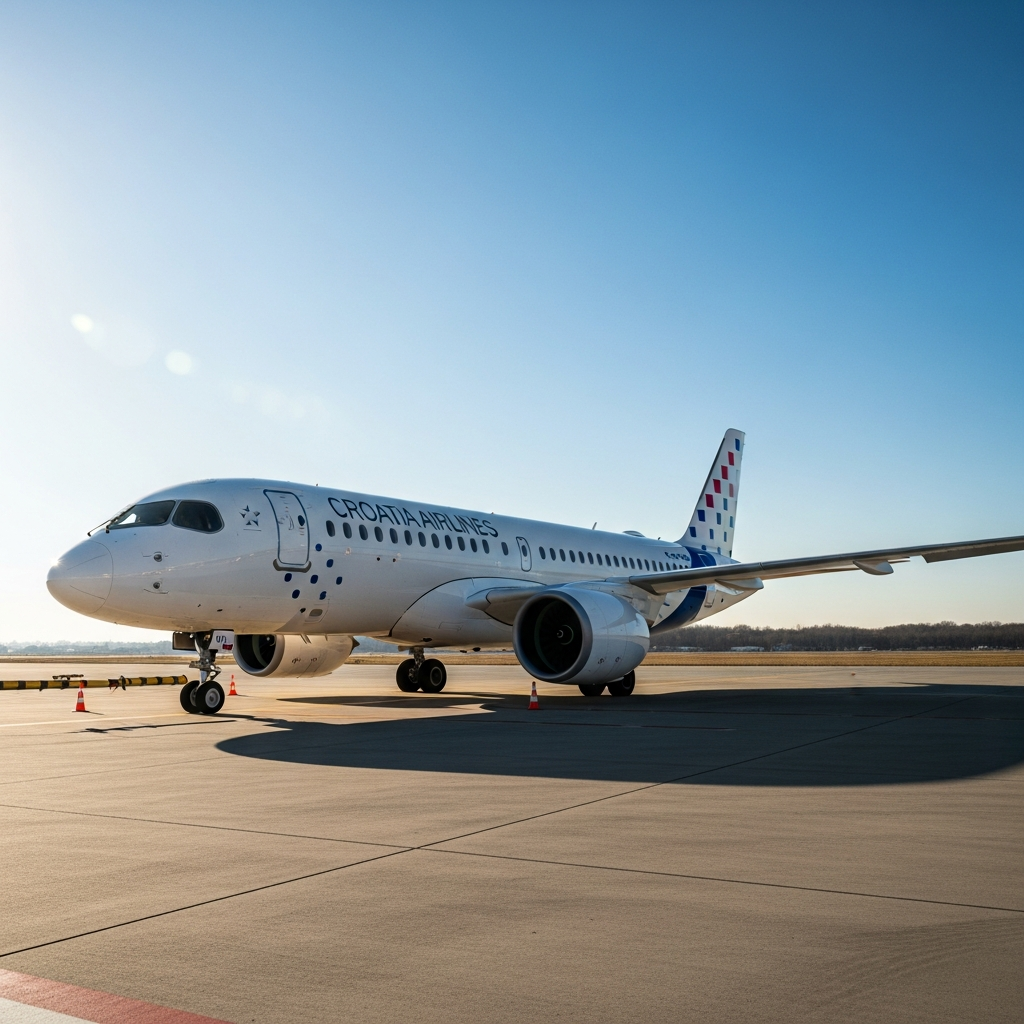
A Croatia Airlines Airbus A220-300 veered off the runway at Split Airport on 16 May 2026 after its crew aborted takeoff at high speed, coming to rest roughly 6,000 feet down Runway 23 on the grass overrun area. The aircraft, registered 9A-CAN, had swung sharply left off the paved surface during the rejected takeoff.
All 130 passengers and five crew members — two pilots and three cabin crew — walked away uninjured. Flight attendants managed a calm, controlled disembarkation directly onto the airfield. No emergency slides were deployed. Croatia Airlines bused passengers to the terminal and arranged a replacement aircraft to continue the delayed Frankfurt service — originally scheduled as flight OU412 with a 13:00 departure.
What Happened on Runway 23
The crew began the takeoff roll at approximately 13:30 local time. Speed was the critical detail. Early reports indicate 9A-CAN reached approximately 131 knots during the roll, with the abort executed at around 123 knots — close to rotation speed. The A220 veered hard left, crossed the runway edge, struck a vertical runway marker and several edge illumination lights, and shed at least one landing gear wheel in the process.
Croatia’s Air, Maritime and Railway Accident Investigation Agency (AIN) classified the event as a serious incident. The agency confirmed the aircraft sustained minor material damage, including to its left engine cowling.
The runway closure shut down Split Airport entirely for roughly three hours. Inbound flights were diverted while technical teams worked through the afternoon to tow 9A-CAN clear of the grass and restore operations.
“The crew aborted takeoff in line with prescribed safety procedures. All passengers and crew members are safe, and no injuries have been reported.”
— Croatia Airlines official statement
Split Airport Deputy Director Pero Bilas confirmed the aircraft veered off the runway during the acceleration phase “for reasons that are not yet known.”
Weather — A Key Variable
Conditions at Split were already challenging. METAR data recorded at the time showed wind from 310° at 17 knots, gusting to 27 knots, with light rain, few cloud at 1,800 feet, embedded towering cumulonimbus at 2,500 feet, and broken cloud at 4,500 feet.
For the A220-300, Airbus FCOM guidance reduces the maximum demonstrated crosswind from 32 knots on a dry runway — also 32 knots on a wet or damp surface with good braking action — down to 27 knots in good-to-medium braking conditions, 20 knots in medium braking conditions, and just 10 knots in medium-to-poor or poor conditions. Investigators are examining whether a sudden, severe crosswind gust during the high-speed roll destabilised the aircraft and prompted the abort. Runway contamination from rainfall is also considered a likely factor in the braking dynamics.
The Aircraft — Brand New, Barely a Year Old
9A-CAN was delivered to Croatia Airlines in June 2025, making it approximately 11 months old at the time of the incident — part of the carrier’s ongoing fleet renewal program. Croatia Airlines currently operates eight A220s — six A220-300s and two smaller A220-100s — with fourteen total planned by end of 2026.
The timing is awkward. CEO Jasmin Bajić recently described 2026 as “particularly demanding,” with seven new aircraft inducting while five older jets phase out simultaneously. Losing 9A-CAN to an extended inspection period — with peak summer season weeks away — adds pressure to an already stretched fleet transition.
The A220-300 is powered exclusively by the Pratt & Whitney PW1500G geared turbofan. No engine malfunction has been confirmed here. Investigators will download flight data and cockpit voice recorders and examine braking dynamics, control surface inputs, and maintenance logs. Aviation experts have separately noted that the PW1500G’s history — including a 2021 Air Baltic automatic dual-engine shutdown on landing in Copenhagen, triggered by erroneous uncontrolled high-thrust detection, and prior FAA warnings about unannunciated engine shutdowns leading to compromised braking — makes thorough recorder analysis critical, even if an engine issue is far from established in this case.
“The aircraft is currently at Split Airport awaiting inspection by the relevant authorities. Technical checks and official procedures are ongoing.”
— Croatia Airlines
What to Watch Next
Croatia’s AIN will lead the formal investigation in coordination with the Croatian Civil Aviation Agency. Cause determination will require full recorder analysis, crew interviews, runway friction data, and a review of weather records against the aircraft’s actual track deviation. Until that work is complete, 9A-CAN stays grounded.



Stay in the loop
Get the latest aircraft insider updates delivered to your inbox.