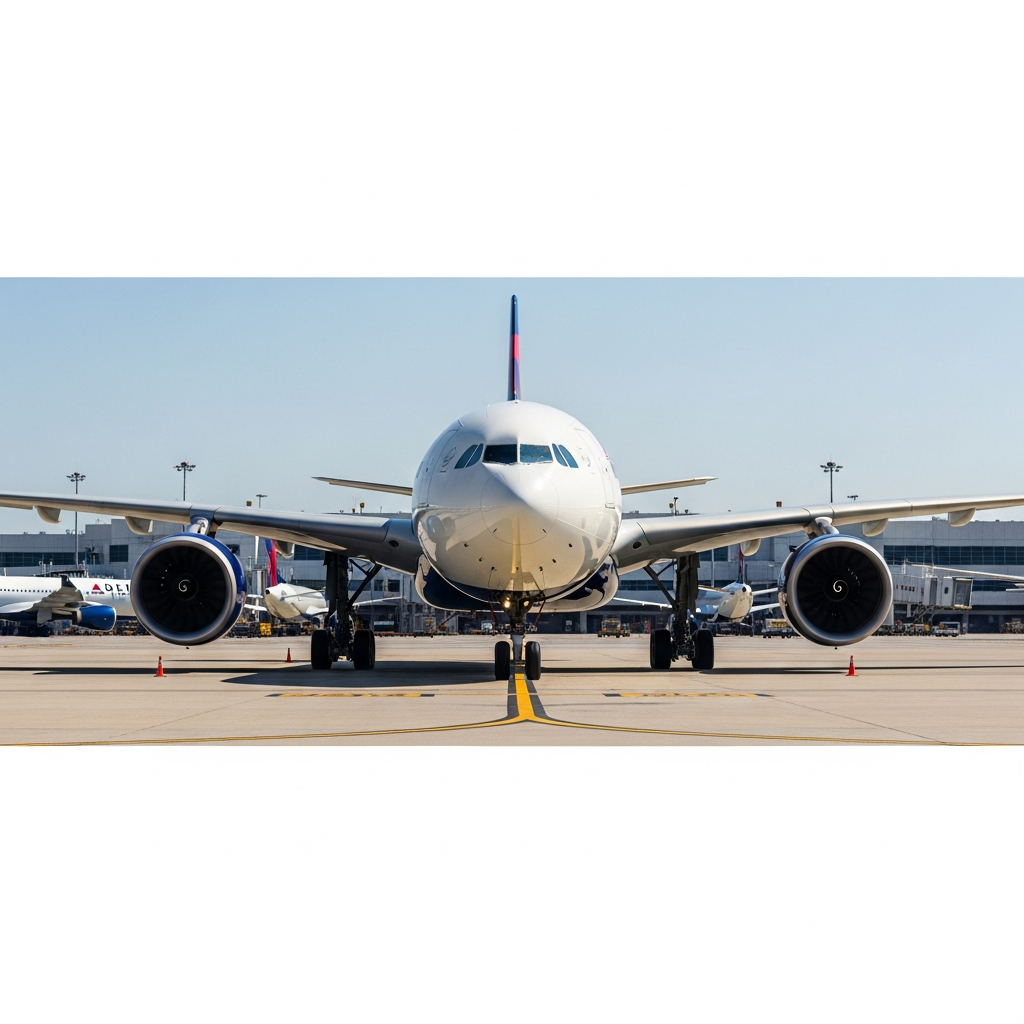
A Delta Air Lines Airbus A330-300 diverted to Paris Charles de Gaulle Airport in the early hours of Tuesday, May 19, 2026, after passengers reported a loud explosion-like bang, visible flashes, and a partial loss of cabin power traced to the aircraft’s left engine — all occurring at cruise altitude over French airspace.
Flight DL286 had left New York’s John F. Kennedy International Airport at 4:28 PM EDT on Monday, May 18, bound for Milan Malpensa Airport (MXP). The aircraft — registration N818NW, an 18-year-old A330-300 and a former Northwest Airlines airframe absorbed into Delta’s fleet in December 2009 following the merger — was cruising somewhere between 35,000 and 37,000 feet when the crew identified a serious anomaly with the port engine. The aircraft had just entered French airspace.
The crew squawked 7700, the internationally recognized general emergency transponder code, and turned sharply left toward Paris. Touchdown at CDG came at 6:23 AM local time Tuesday. Emergency ground crews met the plane on arrival — standard protocol for any inbound 7700 — and the A330 was escorted to a remote stand for technical inspection.
What Passengers Experienced
Passenger video that spread widely on social media shows flashes and sparks from the left engine. Accounts describe a sudden loud bang, then darkness — cabin lighting, entertainment screens, and charging systems all went offline. Flight attendants moved quickly to reassure passengers while the flight deck managed the diversion.
No injuries were reported. The aircraft stayed stable throughout. That’s partly down to the A330’s engineered redundancy — the aircraft carries multiple engine-driven generators, an auxiliary power unit, batteries, and a deployable Ram Air Turbine capable of providing emergency hydraulic and electrical power if primary systems fail.
Delta described the event as an “operational/technical issue” pending investigation. As of May 20, no detailed official statement specific to DL286 had been released. Simple Flying reports it has contacted Delta for comment.
The Replacement Aircraft and Milan Continuation
Delta arranged a replacement Airbus A330-900neo to complete the Milan leg. The substitute aircraft departed Paris later Tuesday, delivering passengers to Malpensa several hours behind the original schedule.
A Pattern Delta Cannot Ignore
This wasn’t an isolated event. On March 29, 2026, a sister ship — registration N813NW, also an A330-300, also a former Northwest airframe — was forced to return to São Paulo Guarulhos shortly after takeoff on Delta flight DL104 when its left Pratt & Whitney PW4168 engine suffered what aviation analysts later described as a severe compressor stall, producing audible explosions and what commentators noted appeared to be sustained fire. Brazil’s CENIPA is investigating that incident.
Then on May 2, 2026, Delta flight DL59 — an A330-900neo on the London Heathrow to Boston route — made an overweight emergency landing in Dublin after the crew throttled one engine to idle following abnormal readings over the North Atlantic.
Pull back further and the pattern keeps going: a Delta Boeing 737-900 lost its left engine on takeoff from Savannah in February 2026, igniting a grass fire; a Delta Boeing 767-400 suffered an engine fire after departing Los Angeles in July 2025.
Delta operates 31 Airbus A330-300s with an average fleet age of 17.2 years. The PW4168A engine common to many of these airframes is drawing pointed scrutiny from aviation commentators, some of whom have called for FAA inspection of all in-service examples. Both N818NW and N813NW are powered by this engine family.
What Comes Next
FAA and European regulations mandate comprehensive reporting of in-flight emergencies. The NTSB holds jurisdiction over incidents involving U.S.-registered aircraft on U.S. carriers; EASA will have a parallel interest given the European airspace involved. As of this writing, no formal investigation announcements from either body had been published.
The central questions for investigators will be familiar from São Paulo: whether the failure was contained, what role fleet age and engine cycle count played, and whether the PW4168A’s maintenance and inspection intervals remain adequate for aircraft of this vintage flying high-cycle transatlantic routes. Both investigations will be monitored as formal findings emerge.
Sources
Passenger cabin reference: Aircraft substitutions remain possible after an operational event. Travelers assigned Delta’s A330-900neo can review the current Comfort seat layout and upgrade benefits.
Stay in the loop
Get the latest aircraft insider updates delivered to your inbox.