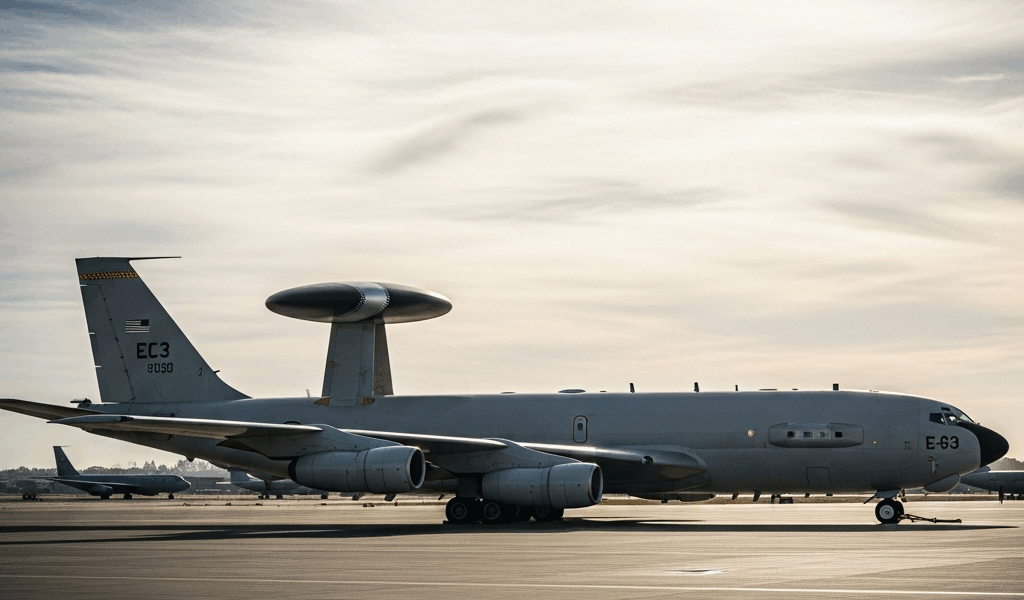
First-Ever Combat Loss — E-3G Sentry AWACS Destroyed at Prince Sultan Air Base
An Iranian missile and drone strike destroyed a U.S. Air Force E-3G Sentry AWACS aircraft at Prince Sultan Air Base in Saudi Arabia on March 27, 2026 — the first time a Boeing E-3 has been lost in combat in nearly five decades of service. The aircraft, tail number 81-0005, was assigned to the 552nd Air Control Wing out of Tinker Air Force Base, Oklahoma. It had been forward-deployed as part of Operation Epic Fury, which began February 28 when the United States and Israel initiated strikes against Iran.
The damage was extensive. Satellite imagery provided to CNN by Airbus, captured March 29, showed large sections of the center fuselage burned out — and the distinctive 30-foot rotodome, which houses the AN/APY-2 surveillance radar, detached and lying on the ground. Photos of the rear fuselage, completely burned out, had already spread widely after first appearing on the Air Force amn/nco/snco Facebook page. At least 10 U.S. service members were injured on the ground, with some sources putting that number as high as 15, five of them seriously. Multiple other U.S. aircraft were also damaged in the strike.
What Was Lost — The E-3G’s Role in the Battlespace
The E-3G is not simply a surveillance platform. Built on a modified Boeing 707-320B airframe and powered by four Pratt & Whitney TF33 turbofans, it carries a flight crew of four alongside 13 to 19 mission specialists working up to 14 consoles at once. Its AN/APY-2 radar sweeps 360 degrees, detecting low-flying targets beyond 400 kilometers and monitoring up to 120,000 square miles of battlespace continuously. In the current conflict, a flying E-3 could detect an incoming Iranian Shahed drone roughly 85 minutes earlier than ground-based radar. That gap matters enormously — it’s the difference between an organized defensive response and a reactive scramble.
“The value of the E-3 and the battle managers is they see the big picture. They’re the chessmaster, while [fighter pilots] are the bishops.” — Heather Penney, former F-16 pilot, Mitchell Institute for Aerospace Studies
Penney added that the loss is “incredibly problematic, given how crucial these battle managers are to everything from airspace deconfliction, targeting, and providing other lethal effects that the entire force needs.” CNN military analyst and retired USAF Colonel Cedric Leighton went further. He suggested the precision of the strike points to outside targeting assistance: “Russia most likely gave Iran geographic coordinates and satellite imagery that provided the precise location.” Ukrainian President Zelenskyy separately echoed that assessment.
A Fleet Already Running on Empty
The timing could hardly be worse. The U.S. E-3 fleet has shrunk from 32 aircraft in 2015 to just 16 today — the last airframe delivered by Boeing in 1992. In fiscal year 2024, the fleet posted a mission-capable rate of just 55.68 percent, meaning fewer than nine aircraft were operationally available on any given day. The Air Force deployed six E-3s to support Operation Epic Fury, roughly 37.5 percent of the total fleet, likely leaving only two or three available stateside. The out-of-production TF33 engines have been a chronic sustainment problem for years.
“Again, the E-3 fleet [is] barely operational now… my concern is that you’ve got a situation where you’re not going to be able to use more duct tape to hold things together.” — Sen. Lisa Murkowski, June 2025
The intended replacement — the Boeing E-7A Wedgetail — was cancelled by Secretary of Defense Pete Hegseth, who called it “expensive and gold-plated,” opting instead for an E-2D Hawkeye gap-filler and a future space-based solution. That decision looks considerably more consequential today. Kelly Grieco of the Stimson Center noted the strike fits a deliberate Iranian targeting pattern — radar infrastructure, aerial refueling tankers, and now AWACS — hitting what she described as “critical enablers of U.S. air power” in sequence.
What Comes Next
81-0005, nicknamed “Captain Planet” within the 552nd ACW, flew through Desert Storm, the Balkans, and two decades of Middle East operations before its service ended on a Saudi taxiway. Two additional E-3s were still visible in open parking at Prince Sultan as late as March 29 — unsheltered, two days after the attack. U.S. Central Command has declined to comment. Tracking continues on force protection posture, fleet readiness numbers, and any movement toward accelerating the E-7A program or reconsidering its cancellation entirely.

Leave a Reply