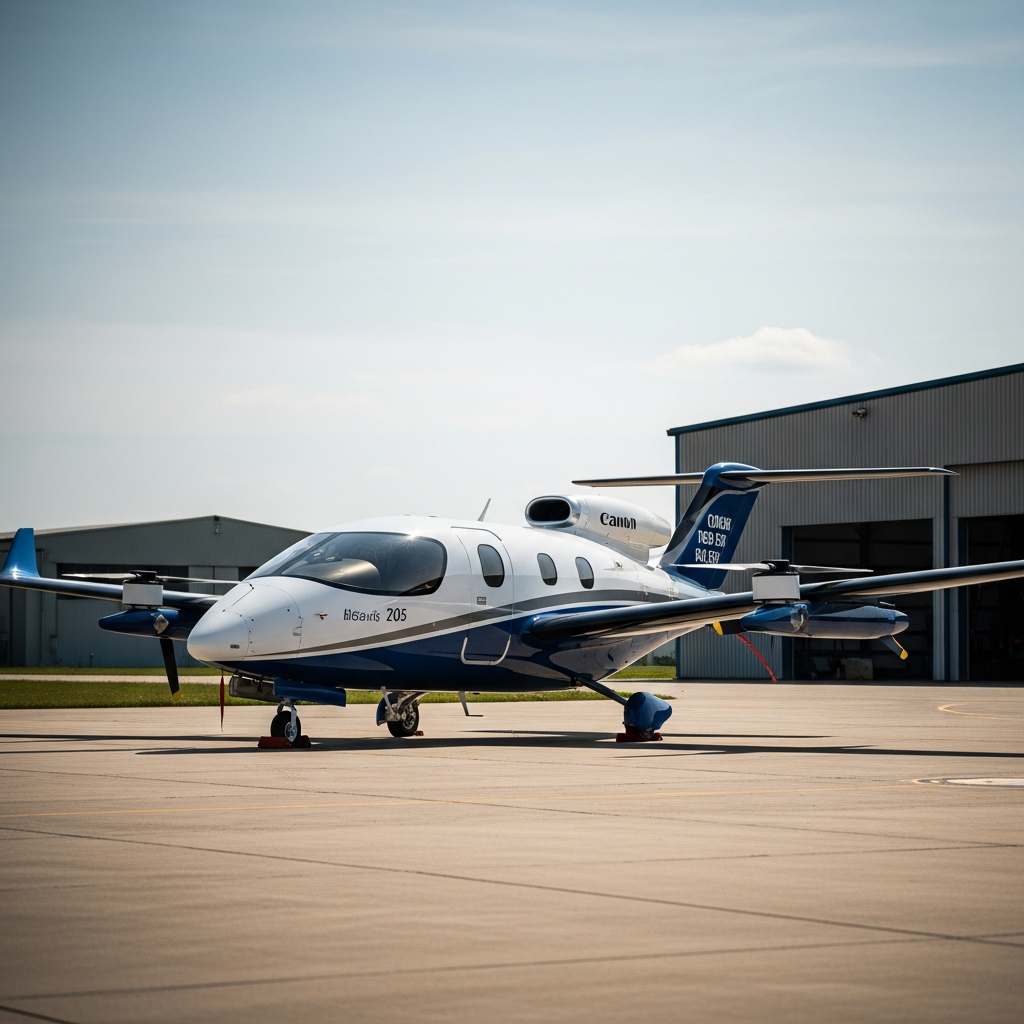
Eve Air Mobility has wrapped up its hover and low-speed flight testing block on its full-scale engineering prototype—a major milestone for the Brazilian eVTOL developer as it pushes toward wingborne flight. Transition flight testing is now scheduled to begin in July or August 2026, with ground validation work underway over the coming weeks.
On May 21, 2026, the hover and low-speed block concluded after 59 flights totaling 2 hours, 27 minutes, and 33 seconds of airtime. The uncrewed prototype completed more than 100 flight test points across those sorties, hitting a maximum altitude of 215 feet and a longest flight duration of 3 minutes and 48 seconds. The data validated control laws, downwash effects, thermal behavior, propulsion models, and simultaneous four-axis maneuvers at speeds up to approximately 20 knots.
“Closing this phase validates the discipline behind our flight test strategy,” Eve CEO Johann Bordais said. “Across 59 flights, we confirmed stable hover performance and predictable control behavior within the envelope, while expanding our understanding of loads, aerodynamics, propulsion and energy management, key foundations for the transition phase and the certification path ahead.”
Testing took place at Embraer’s facility in Gavião Peixoto, São Paulo. The prototype showed strong results across several critical areas. Propulsion and battery performance exceeded expectations. Noise levels matched projections. The team also validated the aircraft’s autoland capability and a secondary simplified fly-by-wire mode—a backup system if the primary control mode fails. For any uncrewed eVTOL heading into passenger service, that safety redundancy matters.
Transition Flight — The Next Envelope Expansion
Transition represents a fundamental shift. During hover, eight vertical lifters handle all vertical thrust. Once transition begins, the pusher propulsion system engages and the aircraft moves horizontally. Lift generation gradually shifts from rotors to the wing. Eve plans to start at 30 knots, building progressively to over 85 knots—the speed where the wing alone provides all lift required for sustained flight.
Marcelo Basile, Eve’s head of tests, underscored why this gate matters: “Completing hover and low-speed testing gives us high-confidence data to validate and refine our aerodynamic, propulsion and load models. That model correlation is what enables disciplined envelope expansion.”
Before the July-August transition block begins, Eve will upload refined flight computer software and run final ground tests on the pusher and actuator systems—the mechanical linkages that control wing surfaces during transition to wingborne flight. This groundwork is essential. Transition is aerodynamically complex, and the synchronization between lifter and pusher systems must be thoroughly validated before the aircraft leaves the ground.
Path to Certification and Production
Eve is targeting 2028 for type certification from Brazil’s National Civil Aviation Agency (ANAC). That represents a shift from earlier timelines as the company prioritizes methodical risk reduction. Manufacturing is already underway at its facility in Taubaté, São Paulo, where Eve is building conforming prototypes. Six aircraft will be produced for the certification flight test campaign.
The company holds 2,800 aircraft orders on its backlog. Earlier this year, it secured $150 million in debt financing to support development and industrialization. Once the first production prototype flies in 2027, Eve plans to introduce controlled failure scenarios—motor shutdowns among them—to validate safety systems before launching the certification campaign.
Nearly 300 flights are planned for 2026. Transition testing is expected to commence within weeks. Eve’s building-block approach stands apart from some competitors already flying full cruise missions. Whether this incremental methodology yields a faster path to certification remains an open question for the urban air mobility sector.

Stay in the loop
Get the latest aircraft insider updates delivered to your inbox.