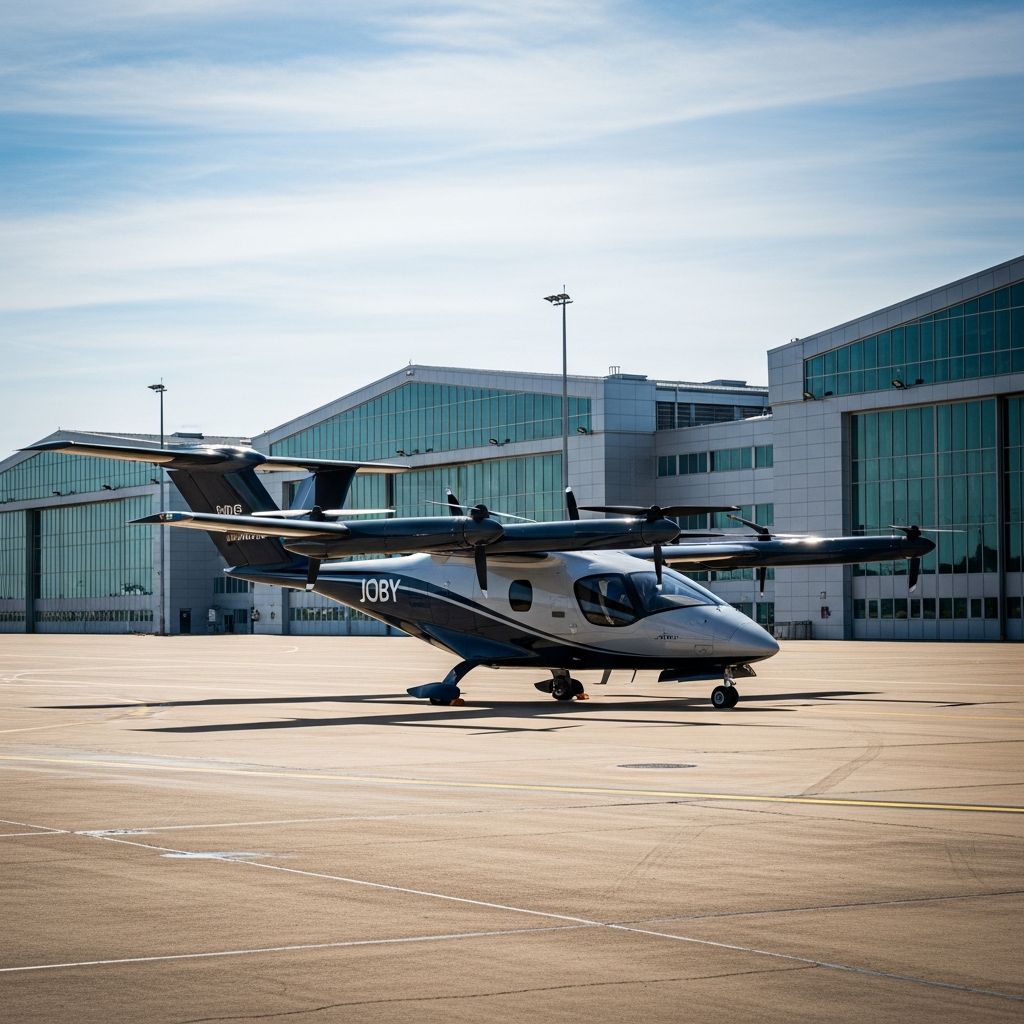
Joby Aviation this week announced it’s acquiring a 700,000-square-foot manufacturing facility in the Dayton, Ohio area. It’s a significant move as the company ramps up to produce four electric air taxis per month by 2027.
The facility sits at 1669 Capstone Way and is ready to go immediately. This marks Joby’s second major production hub—a shift from building prototypes to actually manufacturing aircraft at scale. Joby is paying $61.5 million for the property, which it’s acquiring from Capstone STS. Operations are expected to start in 2026.
“This site will not only support our near-term plan to double production, it can also serve as a base for significant future growth, as we turn a decade of engineering into the manufacturing scale the market is now demanding,” said JoeBen Bevirt, Joby’s founder and CEO. “From the world’s first aircraft factory to the Wright-Patterson Air Force Base, Dayton has long been the epicenter of aerospace innovation and we’re proud to be building the next generation of flight right here.”
Scaling Production for 2026 Certifications
The new Dayton facility works alongside Joby’s existing 140-acre site at Dayton International Airport, which the company acquired in March 2024. Component manufacturing started there in late 2025, and the original location has room to eventually expand to 2 million square feet. Meanwhile, Joby’s pilot production line in Marina, California keeps humming along at roughly 25 aircraft per year.
Timing matters here. In late March 2026, the FAA confirmed that Joby completed Stage 4 of its type certification process—the airworthiness conformity review that puts the company on the edge of landing the first commercial certificate ever issued to an electric vertical takeoff and landing aircraft in U.S. history. Stage 5, final approval, should come within months.
The spending is accelerating. “We spent $41 million on capital expenditure in 2024,” said Paul Sciarra, Joby’s executive chairman. “With these investments, you can expect that figure to increase as we build out our facilities in both Marina and Ohio.”
The Aircraft and Manufacturing Challenge
Joby’s S4 is a five-seat eVTOL with six rotors. It cruises at 200 mph, has a range of roughly 150 miles per charge, and features six independent electric motors driving five-bladed composite variable-pitch propellers. The avionics are triple-redundant fly-by-wire systems. The noise level—65 dBA at 100 meters during takeoff and landing—is roughly as loud as two people having a conversation, a major advantage for operations in cities.
Those propeller blades are complicated to make. Each aircraft needs 30 blades total—five per propeller—and they’re manufactured through intricate carbon fiber processes. Getting to four aircraft per month means producing up to 15,000 blades annually. Joby started making these blades at its original Dayton facility in October 2025, marking the first real phase of Ohio production.
Toyota has invested $750 million in Joby across two tranches—$500 million announced in October 2024 and $250 million closed in May 2025. The automaker has sent engineers to implement the Toyota Production System across Joby’s operations, focusing on manufacturing efficiency and supply chain discipline.
What Comes Next
Joby was selected for five of the pilot projects under the FAA’s eVTOL Integration Pilot Program, which covers operations in the New York/New Jersey area, Texas, Florida, North Carolina, and Utah. On April 27, 2026, Joby made history—operating the first point-to-point flight by an eVTOL aircraft in New York City, taking off from JFK and landing at the West 30th Street Heliport in roughly 15 minutes.
Getting to profitability requires hitting manufacturing targets. The new Dayton facility provides the physical space. Whether Joby can actually produce four aircraft per month—and eventually reach the 500-aircraft-per-year throughput originally announced—will decide if electric air taxis become a real commercial service or stay a luxury toy for the wealthy.
Stay in the loop
Get the latest aircraft insider updates delivered to your inbox.