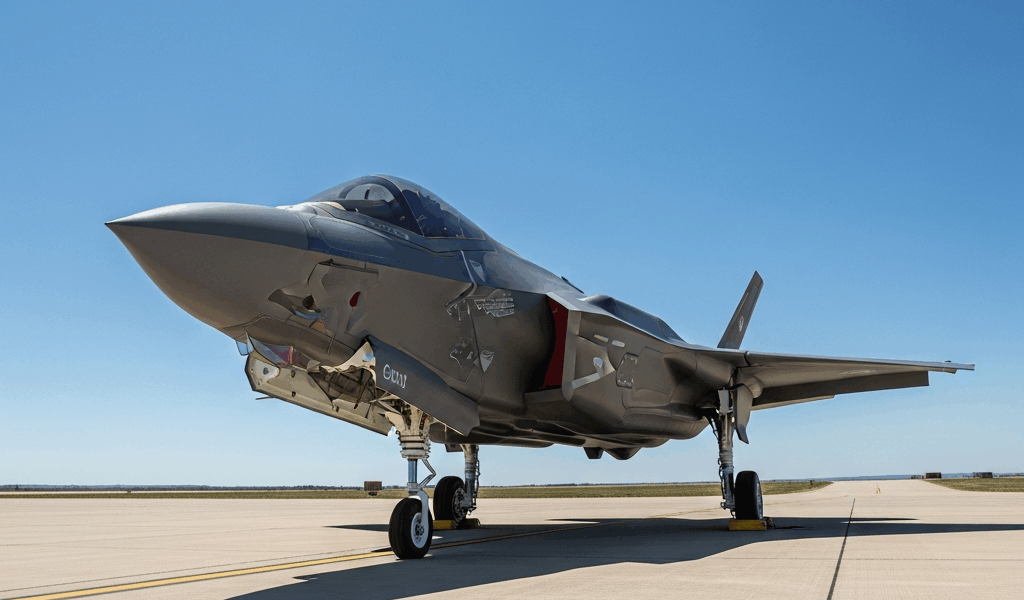
F-35A Crashes at Nellis Air Force Base — Pilot Ejects Safely Over Nevada Test Range
A U.S. Air Force F-35A Lightning II assigned to Nellis Air Force Base crashed March 31, 2026 over the Nevada Test and Training Range. The pilot ejected safely and sustained only minor injuries — making this the first accidental loss of an F-35 since January 2025.
It happened around noon local time, roughly 25 miles northeast of Indian Springs, Nevada, inside the controlled airspace and restricted federal property of the NTTR. The 57th Wing at Nellis confirmed the loss in a formal statement shortly after.
“Emergency responders are on-scene and there is no impact to populated areas. The pilot is safe and being treated for minor injuries. The safety of our personnel and the community remain our top priority.” — 57th Wing, Nellis Air Force Base
Radio traffic and social media caught it first. Listeners noted an HH-60W Jolly Green II helicopter departing Nellis twice under a “RESCUE” callsign — not the kind of pattern that goes unnoticed. A Nellis spokesperson confirmed to Military.com that the pilot was headed to a hospital: “Last that we know he was on his way to the hospital to get checked out.”
What We Know About the Crash
KSNV News 3 Las Vegas reported that sources indicated the pilot ejected after the aircraft had difficulty maneuvering — a phrase that covers everything from a flight-control failure to an engine problem. As of April 4, Air Force officials had not publicly identified a cause. A formal mishap investigation is underway.
The pilot got out via the Martin-Baker US16E ejection seat, the standard system across all three F-35 variants. The US16E deploys an airbag-based head and neck protection system — three inflatable devices, two positioned on the sides of the aircrew’s neck and a third above the head — designed to keep head forces within tolerance during high-speed ejections. It’s the only qualified ejection seat certified to meet U.S. Government Neck Injury Criteria across the full pilot accommodation range.
The tail number hasn’t been publicly released. At current flyaway pricing, the airframe alone represents roughly $82.5 million. Add the F135 engine at $20.4 million and the total loss exceeds $100 million.
The 57th Wing — Not a Routine Hop
This wasn’t a student pilot on a training sortie. The 57th Wing develops advanced air combat tactics and integrates new weapons and systems across the Air Force inventory. Its 65th Aggressor Squadron flies the F-35A specifically to simulate peer and near-peer stealth threats during Red Flag exercises and to support the USAF Weapons School curriculum. Whatever mission the downed jet was flying, losing it sets that work back.
The NTTR spans roughly 5,000 square miles and 2.9 million acres — one of the largest blocks of restricted military airspace in the world. The crash remained entirely within federal property, with no risk to civilian air traffic or populated areas.
Fleet Readiness — Already Under Pressure
The timing is bad. The 2024 DoD Director of Operational Test and Evaluation report found the fleet mission-capable just 51% of the time, against a 65% target. A December 2025 Pentagon Inspector General report went further — citing a 50% average availability rate across all services, 17 percent lower than the average minimum performance requirement, and finding a systemic inability to meet sustainment contract requirements. Squadrons have been cannibalizing parts from grounded jets to keep others flying.
The program carries an estimated lifetime cost exceeding $2 trillion, the largest acquisition program in DoD history, with $442 billion in acquisition costs and $1.58 trillion in projected sustainment. Technology Refresh-3 — the software and hardware upgrade underpinning the jet’s Block 4 capabilities — remained behind schedule throughout FY2024 and is still in developmental testing.
Operational tempo is piling strain on top of structural readiness problems. F-35As have flown combat missions over Iraq, Iran, and Venezuela in both 2025 and 2026, stacking real-world wear onto a fleet that was already struggling to meet availability benchmarks before the shooting started.
What to Watch
The mishap investigation will determine whether the cause points to a mechanical failure, a systems anomaly, or aircrew factors. The January 2025 Eielson crash — in which frozen hydraulic fluid was identified as the mechanical cause, alongside multiple contributing factors including inadequate servicing procedures and crew decision-making, with the pilot spending 50 minutes on a conference call with Lockheed Martin engineers before the loss — produced significant embarrassment for both the program office and the contractor. If this investigation surfaces another systemic issue, expect congressional pressure to intensify. We’ll continue to monitor for official findings.
Sources
- Air & Space Forces Magazine — F-35 Crashes at Nellis Air Force Base in Nevada
- Military.com — Pilot Survives F-35 Fighter Jet Crash in Southern Nevada




Leave a Reply