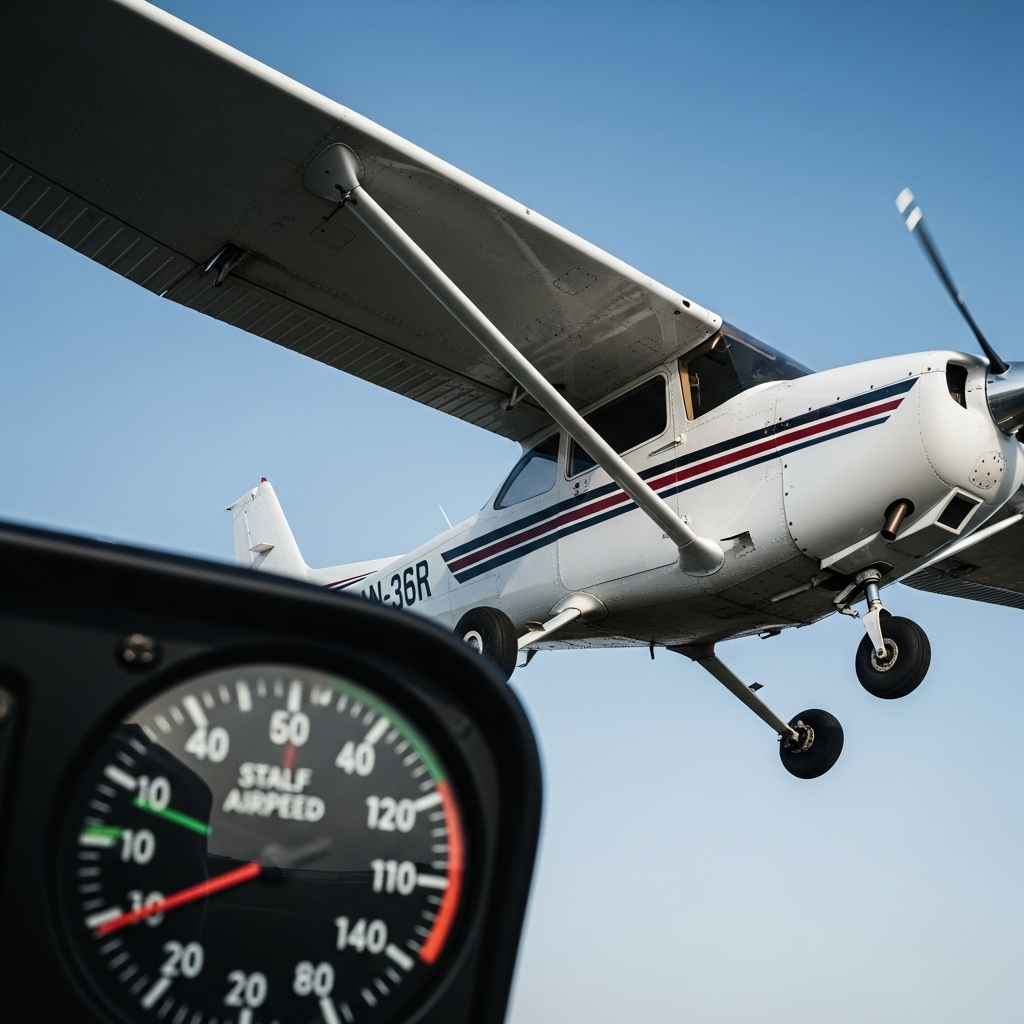
What the POH Actually Says About Stall Speed
Stall speed has gotten complicated with all the memorization shortcuts and oversimplified briefings flying around. I spent my first year as a commercial pilot thinking it was just one number — flip to the right page, write it on your kneeboard, done. That was wrong. The Cessna 172 stall speed numbers every pilot should know aren’t sitting neatly on a single POH page waiting for you.
So, without further ado, let’s dive in.
But what is stall speed, really? In essence, it’s the minimum airspeed at which your wing generates enough lift to keep flying. But it’s much more than that — it shifts depending on weight, configuration, and how aggressively you’re maneuvering. The 2008 Cessna 172S POH is still the widely-referenced standard, and here’s what it actually says: power-off stall speed — Vs — sits at 48 knots with zero flaps at gross weight. Clean. Memorable. Also incomplete.
Vso — power-off stall in full landing configuration, flaps down — drops to 40 knots. That 8-knot gap matters more than most students realize on their first few pattern flights.
Power-on stall speeds tell a different story entirely. Engine at idle, zero flaps: Vsp is 44 knots. Full flaps, prop at idle: roughly 36 knots. Pull the engine out of the picture and the aerodynamics shift in ways that surprise people.
Flaps drop your stall speed because they increase the wing’s lifting ability at low speed — that’s literally their job. Engine power affects airflow over the tail, which changes elevator authority, which changes how the stall break actually behaves. Probably should have opened with this section, honestly. Understanding the why matters more than the numbers themselves.
I learned this the expensive way during my commercial checkride. The examiner asked me to explain why stall speeds differ between configurations. I froze. I’d memorized 48 knots and 40 knots without building any framework around them. The DPE wasn’t cruel about it — he just let the silence sit there until I worked it out myself. Don’t make my mistake.
How Weight Changes Your Stall Speed
Weight changes stall speed in a way that surprises most pilots because the relationship isn’t linear. That’s what makes this concept endearing to us aerodynamics nerds — it rewards the pilots who dig one layer deeper.
The rule: stall speed increases with the square root of the weight ratio. No formula required. A 172 empty weighs around 1,700 pounds. Gross weight is 2,550 pounds. At 1,700 pounds, your Vs — power-off, clean — is roughly 43 knots. At gross weight, you’re at 48 knots. Roughly a 12% weight increase produces about a 5-knot stall speed bump. Not a straight line.
Practically speaking: fly a 172 with two people and minimal fuel — call it 2,000 pounds — and you can land meaningfully slower than the POH suggests. That matters on short-field approaches. Your descent management changes too, because you’re carrying less drag. Too many pilots land a light airplane exactly the same way they land it at gross weight, floating 1,500 feet down a 3,000-foot runway when they could have planted it 400 feet from the numbers.
I’ve watched instructors brief this concept dozens of times. It rarely sticks until a student flies the same approach profile at two different weights and actually feels the difference — the airplane wants to float, then it doesn’t, and suddenly the numbers mean something.
Bank Angle and Load Factor — What the Numbers Mean
Here’s the one that kills pilots. Not metaphorically.
A 60-degree bank creates roughly 2G of load factor. At 2G, stall speed increases by the square root of 2 — approximately 1.41 times. A 48-knot stall speed becomes roughly 67 knots. At 1,000 feet AGL on a base-to-final turn, this is exactly where attention collapses and accidents happen.
A 45-degree bank — nothing unusual, standard pattern work — creates 1.4G. Stall speed climbs to around 56 knots. Most pilots fly 60 knots on final. In a coordinated 45-degree turn, they’re holding 4 knots above their stall speed. Comfortable margin, technically. Add 5 degrees of bank to tighten a wide final, throw in a crosswind correction, let airspeed bleed back 3 knots — the margin disappears.
This is mechanics, not opinion. Bank angle increases the vertical lift component required to maintain altitude, which demands more airspeed. Shallow turns lower the stall speed. Steep turns raise it. Simple.
The traffic pattern is where this bites people. Downwind to base is where bank angle changes fastest. The final approach turn sits at the lowest altitude with the fewest recovery options. Both spots involve significantly elevated stall speeds. Both are also where pilots tend to relax because the sequence feels routine.
Flap Configuration and How It Affects the Numbers
Flaps lower stall speed — but that’s only part of what they do. They also change how the airplane behaves as it approaches that lower speed, and that part catches students off guard.
With zero flaps, the 172 delivers a relatively clean stall break. Buffet, slight pitch-forward, recover. With 40 degrees of flaps — full landing configuration — the break is mushier. Buffeting starts earlier. The pitch break is less crisp. Elevator feel goes soft because the flaps are generating so much lift that there’s little pitch margin left before the actual stall. The whole thing feels different.
Speed difference at gross weight: 48 knots clean, roughly 40 knots with full flaps. That’s a 16% reduction. But the pitch attitude difference is more dramatic than the numbers suggest. At full flaps and 40 knots, the nose-up attitude looks and feels wrong — especially if someone trained heavily on clean stalls. I’m apparently a visual reference pilot, and that attitude picture threw me for weeks before it felt natural.
Students trained exclusively on 40-degree short-field approaches sometimes develop sloppy technique in the flare because the airplane demands more deliberate elevator input. Descent angle changes more gradually. The feedback loop slows down. Worth practicing both configurations until neither one feels unfamiliar.
How to Use Stall Speed When Flying the Pattern
This is where the numbers actually earn their place on your kneeboard.
Standard minimum final approach speed is 1.3 times Vso. At gross weight — Vso of 40 knots — that math puts you at 52 knots on final. Straightforward. But here’s where the weight discussion connects back: fly that same 172 at 2,100 pounds with a 10-knot crosswind and a 3,000-foot runway. Vso at that weight drops to roughly 37 knots. Times 1.3 equals 48 knots. You can fly final at 48 knots, which means less float, shorter rollout, and better crosswind control — because you’re not carrying unnecessary energy into the flare.
The 1.3 multiplier isn’t arbitrary. It builds in gust margin, accounts for minor control input errors, and keeps you at a speed where pitch response is still crisp. At 1.3 Vso, there’s enough energy to recover from a momentary stall and enough authority to manage the airplane through the flare without ballooning.
Quick reference for a 172S at gross weight — at least if you’re using the 2008 POH as your baseline:
- Clean stall (Vs): 48 knots
- Full flap stall (Vso): 40 knots
- Final approach speed (1.3 Vso): 52 knots
- Go-around speed: 55+ knots
Know these numbers. Understand why they shift. That’s the difference between flying the airplane and just riding along while it mostly does the right thing.
Stay in the loop
Get the latest aircraft insider updates delivered to your inbox.