What a 172 Annual Inspection Actually Covers
Cessna 172 ownership has gotten complicated with all the misinformation flying around about what maintenance actually costs. I’ve watched the sticker shock hit new 172 owners dozens of times — they get that first invoice and suddenly realize nobody gave them the full picture. Today, I will share it all with you.
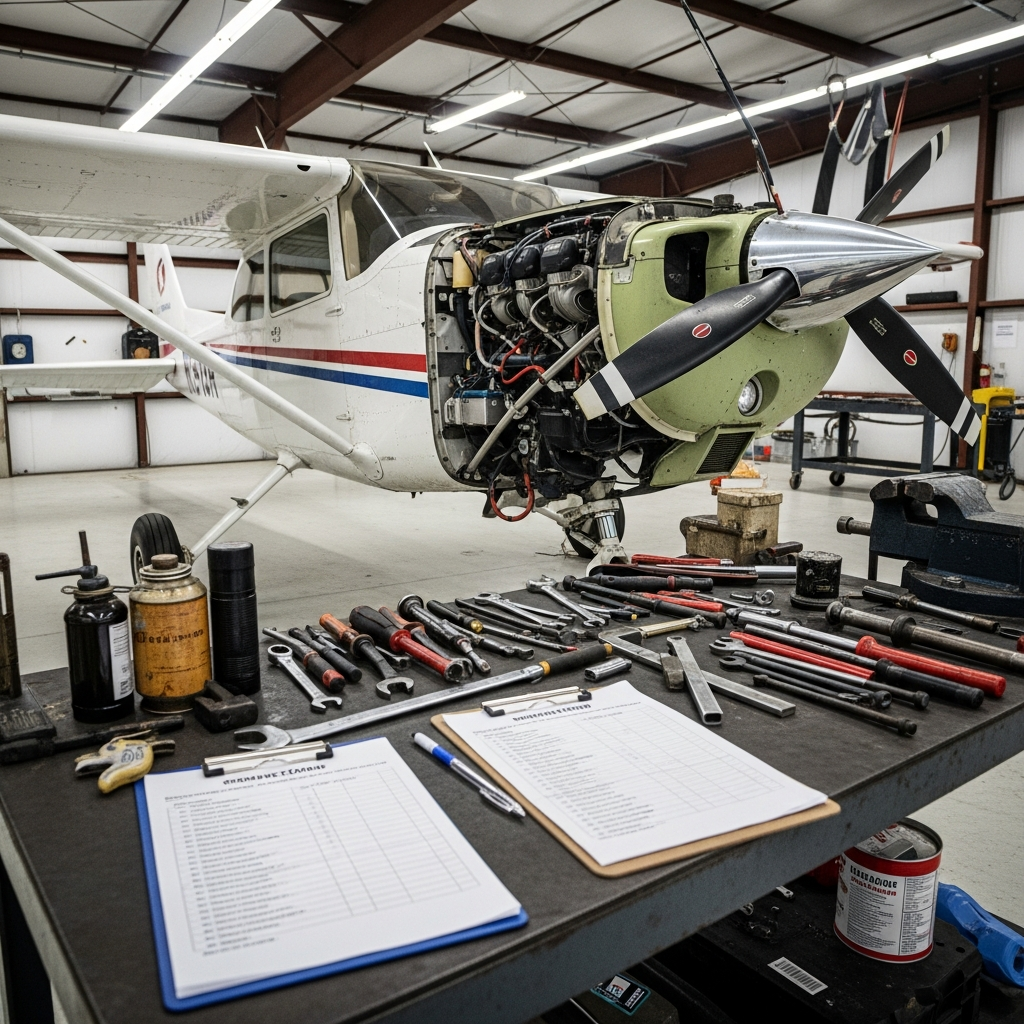
But what is an annual inspection? In essence, it’s the FAA-mandated top-to-bottom teardown and review of your aircraft. But it’s much more than that. Your A&P or IA (Inspection Authorized) mechanic isn’t just kicking the tires. They’re pulling apart major components, checking every hose and fitting for corrosion, running compression tests on the engine’s cylinders, verifying your avionics still meet certification standards, and combing through the entire maintenance logbook — at least if they’re doing it right. For a Cessna 172, that workhorse high-wing four-seater most of us learned to fly in, this typically means 40 to 80 hours of labor depending on age and condition.
The annual covers airframe inspection, engine inspection, systems checks across hydraulics, fuel, and electrical, avionics certification where required, and compliance verification against manufacturer service bulletins and ADs — Airworthiness Directives. Not optional. Fly without a current annual and your aircraft is grounded. No exceptions, no gray area.
Typical Cost Ranges for a Cessna 172 Annual
Probably should have opened with this section, honestly. Let me give you the real numbers instead of the vague ranges you’ll find elsewhere.
A clean annual on a well-maintained Cessna 172 — one where the owner actually ran through preflight checklists and fixed squawks before they became problems — runs between $1,800 and $2,800 combined labor and parts. That’s baseline. I’m talking a 1990s or newer 172 with no major surprises lurking in the logbook.
Here’s how the math actually breaks down:
- Base labor cost: Most A&P shops bill $65 to $125 per hour depending on location and shop type. A straightforward annual takes 45 to 60 billable hours. That’s $2,925 to $7,500 in labor alone — though most 172 annuals don’t push the upper end of that range.
- Parts and fluids: Oil changes, air filter replacement, miscellaneous gaskets and fasteners. Add another $300 to $600 if nothing breaks.
- Required AD compliance: Some years have active ADs demanding specific parts or modifications. This varies wildly by serial number and year — your aircraft might owe nothing, or it might owe $800.
- Transponder and ELT certification: Transponder certification is required every 24 calendar months. Add $300 to $500 when it’s due. ELT battery replacement runs $150 to $300 every 12 months of use.
So a typical, clean Cessna 172 annual lands somewhere between $2,200 and $3,500 total. That’s the real-world number you should write into your budget spreadsheet right now.
A 172 with deferred maintenance? Different animal entirely. I once reviewed an owner’s estimate where corrosion, worn brake pads, questionable hoses, and a mag that needed full overhaul pushed the total to $8,200. The airframe itself was fine. The owner had just ignored the maintenance logs for two years straight. Don’t make my mistake — or rather, don’t make his.
Shop type matters more than people think. A small independent A&P shop typically runs 15 to 20 percent cheaper than an FBO or Part 145 repair station. Smaller shops also tend to call and talk through findings before billing everything out — that personal communication is worth something. FBOs charge premium labor rates but offer convenience and usually have avionics shops on-site. Owner-assisted annuals, where you help tear down and reassemble under your A&P’s supervision, can cut labor costs 30 to 40 percent in some states. Regulations vary, so check before assuming.
What Drives the Cost Up Fast
Here are the specific killers that turn a $2,500 annual into a $6,000 one — and none of them are surprises if you know what to watch for:
- Age-related hose failures. Fuel, vacuum, and brake hoses over 10 years old fail inspection regularly. Replacing them isn’t cheap. A fuel system hose replacement on a 172, with labor, runs $400 to $800 per line. Most aircraft need three or four lines replaced at once.
- Brake and tire work. Brake pads wear. Fluid contamination shows up during annual inspection. Tires that look perfectly fine visually often fail under load. A complete brake overhaul — new pads, fluid flush, cylinder inspection — hits $1,200 to $2,000.
- Cylinder compression issues. An engine past 1,500 hours often shows marginal compression on one or two cylinders. A top overhaul on a single jug runs $3,000 to $5,000 alone. This is exactly why engine overhaul reserves exist — build that fund before you need it.
- Magneto timing and carbon buildup. Magnetos need timing checks every annual. If one’s out of spec, overhaul is required — $800 to $1,500 per mag. Carbon-fouled spark plugs from frequent short flights add extra labor hours too.
- Corrosion and paint. Older 172s, especially those hangared poorly or anywhere near salt air, develop surface corrosion. Small spots need stripping, treating, and repainting. Add $100 to $300 per corroded area, and those areas multiply fast on a neglected airframe.
- Alternator and battery replacement. These don’t fail every annual, but when they do, expect $400 to $900 for a new alternator and $150 to $300 for a battery. Budget for it eventually.
- Gear and prop work. Landing gear service on fixed-gear 172s is typically light. Propeller blade tracking and balancing adds $300 to $600. Retractable gear variants — some 172RG models — require more detailed inspection and servicing on top of that.
The real cost driver isn’t any single line item. It’s the combination. A 1988 172 with 3,000 hours, rough maintenance records, and a paint scheme that hasn’t been touched since the Clinton administration will cost more. A 2005 172 flown regularly, maintained well, and kept hangared will be cheaper. It really is that simple.
How to Keep Annual Costs Under Control
First, keep meticulous maintenance records — every oil change, every spark plug swap, every AD compliance entry. Mechanics love working on aircraft with detailed logbooks. They trust the history and don’t need to spend extra hours investigating unknown squawks. Thin logbooks raise red flags and increase inspection time, which means your bill goes up before they’ve found anything.
Second, fix small squawks immediately rather than deferring them until annual. That slow mag drop you’ve been noticing? Get it checked this week. The alternator output running slightly low? Investigate now. Small issues caught early cost $200 to $500 to address. Left alone until annual, those same issues cost $1,500 to $3,000.
Third, choose your shop carefully. Interview three shops before committing. Ask about their annual process, how they communicate during inspection, and their stance on owner-assisted work. A shop with a reputation for calling owners before authorizing repairs over $500 is worth the extra drive across town.
Fourth — and I’m apparently the kind of person who learns this lesson the hard way — if you haven’t purchased the 172 yet, budget for a pre-purchase inspection. Runs $800 to $1,500. Catches surprises before you own them. I’ve seen buyers walk away after a pre-purchase revealed hidden corrosion or a marginal engine. Far better than discovering it after you’ve signed paperwork and the seller is already cashing your check.
Finally, consider a condition inspection if your aircraft is aging. Some owners run an abbreviated check in off years specifically to catch developing issues early. This runs $800 to $1,200 and can prevent major annual surprises. That’s what makes this kind of proactive ownership endearing to us 172 operators — it’s not glamorous, but it works.
What to Ask Your A&P Before Signing Off
So, without further ado, let’s get into the questions that actually matter — the ones that separate informed owners from people who just blindly sign invoices.
- Will you call me before authorizing any repair over a certain dollar amount? Establish a threshold — $300, $500, $1,000, whatever your comfort level is — and get verbal agreement upfront. This one conversation prevents surprise $4,000 invoices.
- Can I be present during major inspections? Many A&Ps actively encourage this. You learn your specific aircraft and can ask questions as issues surface. Some shops actually require owner presence for insurance reasons.
- Which findings are airworthiness items versus recommendations? Airworthiness items must be fixed before flight. Recommendations are optional. Know the difference. It’s the only way to prioritize your spending intelligently rather than just approving everything on the list.
- Do you have AD compliance history for my exact serial number? Reputable shops maintain this database. They know your aircraft’s specific requirements down to the serial number — not just a general model year guess.
- What’s your realistic turnaround time? Some shops turn annuals in two weeks. Others genuinely need a month. Get a real estimate and plan your flying schedule accordingly.
The Cessna 172 is affordable to maintain compared to most aircraft — that’s not marketing copy, it’s genuinely true. But “affordable” still means budgeting $3,000 to $4,000 annually for a realistic reserve. Plan for it upfront and the annual becomes a routine line item. Ignore it and it becomes a crisis. Every single time.
Stay in the loop
Get the latest aircraft insider updates delivered to your inbox.