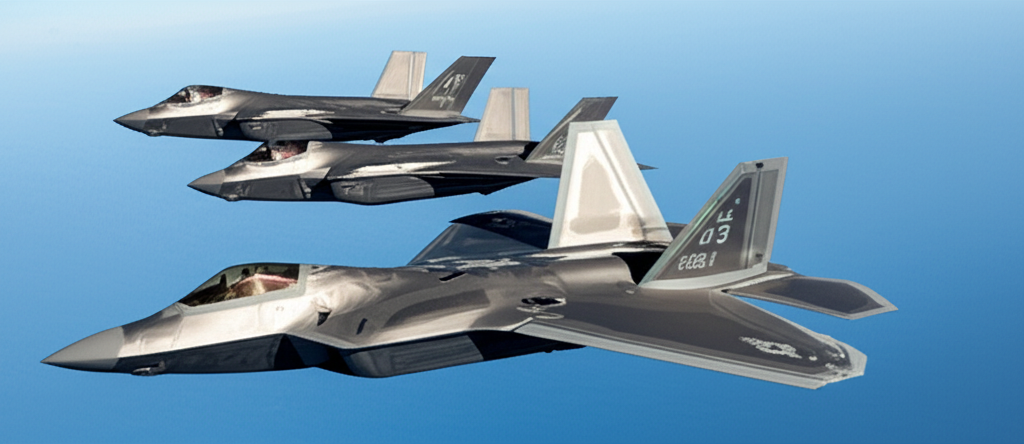
Walk into any aviation forum and ask whether the F-35 or F-22 is the “better” fighter. Then leave. Come back in three days. The argument will still be going.
Here’s the thing everyone misses: they’re not competing. They never were. And the Air Force needs both for reasons that have nothing to do with one being superior to the other.
Different Jobs, Different Planes
The F-22 Raptor is an air superiority fighter. Full stop. It was designed to own the sky against the most advanced threats imaginable—Soviet (now Russian) and Chinese fighters that, in the 1980s planning cycles, were expected to be formidable. The Raptor’s entire existence focuses on finding enemy aircraft and destroying them before they know it’s there.
The F-35 Lightning II is a multirole platform. It conducts strategic attack, close air support, air superiority, electronic warfare, intelligence/surveillance/reconnaissance, and suppression of enemy air defenses. Six distinct mission sets in one airframe.
Comparing them directly is like asking whether a NASCAR stock car or a Jeep Wrangler is “better.” Depends what you’re trying to do.
The Performance Numbers That Actually Matter
The F-22 is faster. Mach 2.25 versus the F-35’s Mach 1.6. But raw speed rarely decides modern air combat. What matters is the F-22’s supercruise capability—sustained supersonic flight without afterburner. That means the Raptor can reach engagement ranges faster while burning less fuel and generating less heat signature than any other fighter in the world.
The F-22 is more maneuverable. Thrust vectoring allows it to point the nose anywhere instantly. In within-visual-range engagements—the classic dogfight—the Raptor is probably unbeatable by any current fighter on the planet.
The F-35, though, might never need to dogfight. Its sensor fusion pulls data from radar, electro-optical systems, datalinks, and offboard sources into a single coherent picture. The pilot sees everything. A former Air Force Chief of Staff described it not as a dogfighting machine but as “a multipurpose, data-integration platform.”
Different philosophies. Both work.
What 186 Raptors Gets You
The Air Force originally planned to buy 750 F-22s. They got 186 before the production line closed in 2011. Budget cuts, changing threat assessments, and the massive cost per unit ($150+ million each) killed the program early.
Those 186 aircraft are the only F-22s that will ever exist. No export sales—federal law prohibits selling them abroad to protect classified technology. Every Raptor lost to accidents or attrition reduces a fleet that cannot be replaced.
This scarcity shapes how the Air Force uses them. Raptors don’t get sent on routine deployments. They don’t fly combat air patrols over low-threat zones. They’re held in reserve for peer-level conflicts where air superiority isn’t guaranteed—the China scenario, the Russia scenario, the fights where second-best means losing.
What 3,000+ Lightnings Gets You
The F-35 program is building over 3,000 aircraft across three variants: the F-35A for conventional runways (Air Force), the F-35B for short takeoff/vertical landing (Marines), and the F-35C for carrier operations (Navy). Twenty allied nations have ordered F-35s. It’s becoming the standard Western fighter jet.
This ubiquity is strategic. When American, British, Australian, Japanese, Israeli, and Italian F-35s can share data seamlessly, communicate in real time, and present a unified picture across an entire theater—that’s a capability no adversary can match. The F-35’s value isn’t just what one plane can do; it’s what thousands of networked planes can do together.
The Honest Comparison Nobody Makes
In a guns-only, within-visual-range fight, the F-22 destroys the F-35. This is not controversial. The Raptor was built for exactly that scenario.
In a beyond-visual-range engagement where sensor advantage determines who shoots first, the F-35’s superior situational awareness might give it an edge. Its radar, electronic warfare suite, and sensor fusion are a generation ahead of what the F-22 carries (though F-22 upgrades are ongoing).
But here’s the honest truth: they’d never fight each other. And if the scenario requires both aircraft types, you’d want the F-22 handling the air-to-air threats while the F-35 handles everything else.
That’s not a bug. That’s the design.
Why the Air Force Keeps Both
Modern air warfare isn’t one mission. It’s dozens of missions happening simultaneously. You need fighters to clear the sky. You need strike aircraft to hit ground targets. You need electronic warfare aircraft to jam enemy radar. You need surveillance platforms to track everything moving. You need suppression aircraft to neutralize surface-to-air missiles.
The F-22 does one of those things better than any aircraft ever built. The F-35 does five or six of them in a single sortie.
Running an air campaign with only F-22s would leave massive capability gaps. Running one with only F-35s would mean accepting air-to-air inferiority against peer adversaries. Running one with both means you have the tools for every situation.
The NGAD Elephant in the Room
The Air Force’s Next Generation Air Dominance (NGAD) program is developing the F-22’s replacement—a sixth-generation fighter that exists mostly as classified briefings and contractor prototypes. When it arrives, probably in the 2030s, the F-22 will begin phasing out.
The F-35 isn’t going anywhere. It’ll fly alongside NGAD the same way it flies alongside the F-22 today: handling the multirole missions while the dedicated air superiority fighter handles the most dangerous threats.
This complementary relationship isn’t temporary. It’s doctrine.
The Forum Argument Solved
So which is better, the F-35 or F-22?
The F-22 is a better air superiority fighter. The F-35 is a better multirole platform. The Air Force needs both because air power requires both.
Arguing about which one “wins” misses the point entirely. They’re not alternatives. They’re partners. And together, they give the United States an air combat capability that no other nation can match.
That’s not opinion. That’s the whole point.


Leave a Reply