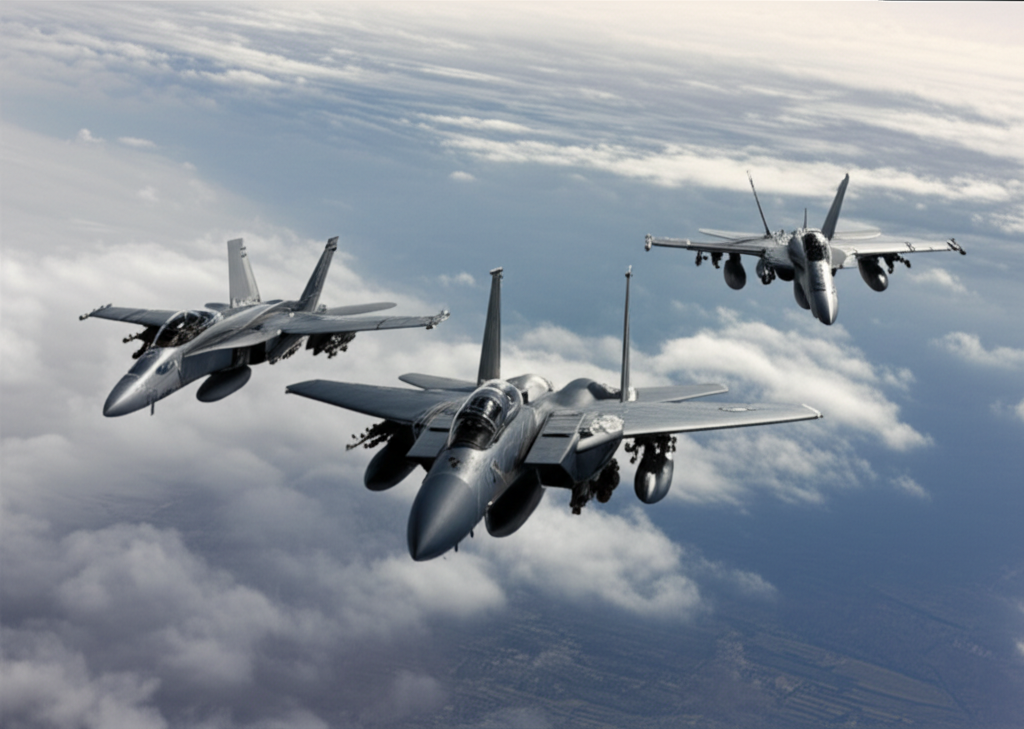
When it comes to American air power, few debates generate as much passion among aviation enthusiasts as the F-15 vs F-18 comparison. Both aircraft have served with distinction for decades, yet they represent fundamentally different approaches to aerial combat. The F-15 Eagle dominates as an air superiority legend, while the F/A-18 Hornet excels as a versatile carrier-based multirole fighter.
Understanding the differences between these iconic aircraft reveals the strategic thinking behind American military aviation and helps explain why both remain in active service today.
Specifications Comparison
| Specification | F-15 Eagle | F/A-18 Super Hornet |
|---|---|---|
| Maximum Speed | Mach 2.5 (1,875 mph) | Mach 1.6 (1,190 mph) |
| Combat Radius | 1,000+ miles | 390+ nautical miles |
| Service Ceiling | 60,000 ft | 50,000 ft |
| Payload Capacity | 23,000 lbs | 17,750 lbs |
| Engines | 2x P&W F100 (29,000 lb thrust each) | 2x GE F414 (22,000 lb thrust each) |
| Primary Operator | U.S. Air Force | U.S. Navy |
| Carrier Capable | No | Yes |
Combat Roles and Mission Profiles
F-15 Eagle: Air Superiority Champion
The F-15 Eagle was designed with a singular purpose: to establish and maintain air superiority over any battlefield. Entering service in 1976, the Eagle was America’s response to advanced Soviet fighters and remains the world’s fastest operational fighter jet at Mach 2.5.
The F-15’s combat record speaks for itself. After five decades of service, the Eagle has never been shot down in air-to-air combat, accumulating over 100 aerial victories. Its APG-63 and APG-70 pulse-Doppler radar systems can detect targets at ranges exceeding 100 miles, giving pilots crucial situational awareness in beyond-visual-range engagements.
The F-15E Strike Eagle variant expanded the platform’s capabilities to include precision ground attack, while the newest F-15EX Eagle II can carry up to 24 air-to-ground munitions or 12 air-to-air missiles simultaneously.
F/A-18 Super Hornet: Naval Versatility
The F/A-18 was designed from the ground up as a multirole fighter optimized for carrier operations. The “F/A” designation stands for Fighter/Attack, reflecting its dual-mission capability that allows the Navy to project power from the sea with fewer aircraft types.
The Super Hornet fills an impressive range of roles: air superiority, fighter escort, suppression of enemy air defenses, reconnaissance, forward air control, close air support, and strike missions. It can even be configured as an airborne tanker to extend the range of other aircraft.
The EA-18G Growler electronic warfare variant demonstrates the platform’s adaptability, providing vital jamming capabilities against enemy radar and communications systems.
Pros and Cons
F-15 Eagle Advantages
- Superior Speed: Mach 2.5 capability outpaces nearly every other fighter
- Longer Range: Combat radius over 1,000 miles reduces tanker dependency
- Greater Payload: Can carry 23,000 lbs of ordnance for sustained operations
- Unmatched Air-to-Air Record: Zero losses in aerial combat over 50 years
- BVR Dominance: Exceptional beyond-visual-range engagement capability
F-15 Eagle Disadvantages
- No Carrier Operations: Limited to land-based airfields
- Higher Operating Costs: More expensive to maintain and operate
- Limited Slow-Speed Maneuverability: Less agile in close-quarters dogfights
F/A-18 Super Hornet Advantages
- Carrier Capable: Operates from aircraft carriers worldwide
- Superior Agility: Excellent high-angle-of-attack performance in dogfights
- True Multirole: Seamlessly transitions between air-to-air and ground attack
- Lower Maintenance: Designed with 42% fewer parts than its predecessor
- Electronic Warfare Variant: EA-18G Growler provides crucial EW capability
F/A-18 Super Hornet Disadvantages
- Lower Speed: Mach 1.6 maximum is slower than many competitors
- Shorter Range: Combat radius under 400 nm requires more tanker support
- Reduced Payload: Carries less ordnance than the F-15
Which Fighter Is Better?
The answer depends entirely on the mission requirements. For pure air superiority and long-range strike missions from established air bases, the F-15 remains unmatched. Its speed, range, and combat record make it the premier air dominance platform.
However, for naval operations requiring carrier-based flexibility, the F/A-18 Super Hornet is irreplaceable. Its ability to launch from aircraft carriers, perform multiple mission types, and maintain lower operating costs makes it essential for power projection from the sea.
The U.S. military wisely operates both aircraft because they serve complementary roles. The Air Force relies on the F-15 for homeland defense and overseas air superiority missions, while the Navy depends on the Super Hornet for carrier air wings that can respond to crises anywhere in the world.
Recent combat operations highlight this partnership. In January 2024, Super Hornets from the USS Dwight D. Eisenhower participated in strikes against Houthi targets in Yemen, demonstrating the Navy’s ability to project power from international waters. Meanwhile, F-15s continue to provide air superiority coverage from bases across the globe.
The Bottom Line
Both the F-15 Eagle and F/A-18 Super Hornet represent the pinnacle of their respective design philosophies. The F-15 wins on raw performance metrics like speed, range, and payload, while the F-18 wins on versatility, carrier operations, and close-range maneuverability.
Rather than declaring one aircraft “better,” aviation experts recognize that American air power benefits from having both platforms in its arsenal. Together, they ensure the United States can establish air dominance in any environment, from land-based operations to carrier strike groups deployed across the world’s oceans.
Stay in the loop
Get the latest aircraft insider updates delivered to your inbox.